

The Loneliness of the Third Kind of Power
The most misunderstood people are not the ones who cannot communicate. They are the ones who communicate in a language most people have not yet learned to speak.

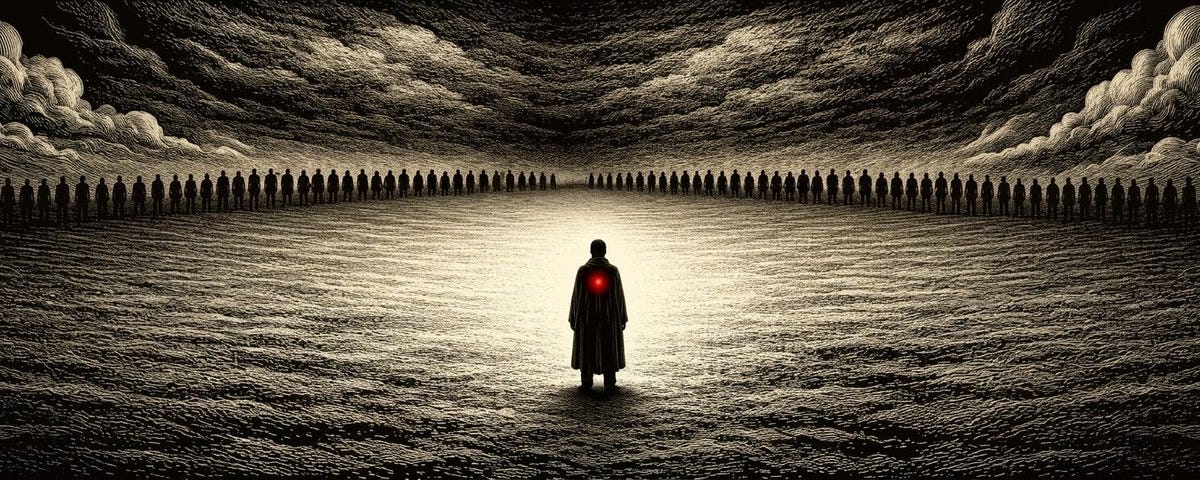
Nobody tells you about the loneliness.
The books about power talk about strategy and leverage and influence and the accumulated advantages of playing the game better than everyone else.
They do not talk about what it feels like to see the game clearly and choose not to play it.
To be the person in the room who understands every move available and has decided that none of them are worth making.
To have people around you running patterns you can see completely and choosing empathy anyway and watching them interpret that choice as confirmation that you did not see the pattern at all.
That specific loneliness has no name in most conversations about power.
It should.
Because it is real. And it is the price of the third kind. And nobody who has not paid it can fully understand what they are asking of you when they tell you to keep choosing the high road.
What the loneliness actually feels like
It is not the loneliness of having no one around.
You can be surrounded by people and feel it completely.
It is the loneliness of being consistently misread.
Of choosing patience and having it called weakness.
Of choosing honesty and having it called naivety.
Of choosing empathy and having it called an opening.
Of doing the most difficult thing available in any given situation and having the people around you see only the surface of it and draw the wrong conclusion about what it means.
The person who fights back is understood immediately. Their strength is legible. Their position is clear. Everyone in the room knows where they stand.
The person who does not fight back is a mystery. And most people resolve mysteries by assuming the simplest explanation. They did not fight back because they could not. Not because they chose not to.
Living inside that misreading is exhausting in a way that is hard to explain to someone who has not experienced it.
Because you cannot correct it without proving it. And proving it requires becoming the thing you chose not to be. Which defeats the entire purpose of the choice.
So you live with being misread.
And you find a way to be okay with that.
Why the misreading happens
Most people have never encountered someone who has genuine power and chooses not to use it.
The framework they have for understanding strength is built entirely on its expression. The person who speaks loudest. Who presses hardest. Who takes up the most space. Who wins the most exchanges.
Strength without expression does not compute in that framework.
So they file you somewhere else.
Passive.
Unaware.
Weak.
Confused.
Not worth taking seriously.
None of those are accurate. But they are the available categories for someone who cannot yet imagine that what they are seeing is a choice rather than a limitation.
That misreading is not your failure.
It is just the gap between where they are and where the understanding of power you have developed requires you to be.
The specific isolation of seeing clearly
There is another dimension to this loneliness that is harder to name.
When you see the game clearly you also see people you care about running patterns that are costing them more than they know.
You see the manipulation in relationships they think are genuine. You see the power dynamics in rooms they think are equal. You see the moves being run on them that they cannot yet recognise because they have not yet developed the pattern recognition to see them.
And you cannot always tell them.
Not because you do not care. Because the seeing has to come from inside. From their own experience. From life hitting them in the specific way that makes the pattern impossible to ignore.
You can offer the observation once. Carefully. At the right moment.
But you cannot make someone see what they are not yet ready to see.
So you watch. And you stay present. And you are there for when the moment arrives that makes them ready.
And in the meantime you carry the knowledge alone.
That is its own specific loneliness.
What makes it bearable
Two things.
The first is clarity about why you made the choice.
The loneliness of the third kind of power is only unbearable when you are not certain that the choice was worth it. When the misreading makes you question whether the empathy was actually strength or whether everyone else was right about what it meant.
That certainty does not come from outside. It comes from the accumulated evidence of your own experience. Every time you chose empathy and remained intact. Every time you refused to use force and found that nothing essential was lost. Every time you were misread and discovered that the misreading did not actually change anything about who you were or what you were building.
That evidence builds slowly. But it builds.
And eventually the certainty becomes solid enough that the misreading stops costing you anything.
Not because it stops happening.
Because you stop needing it to stop.
The second thing that makes it bearable is finding the people who speak the same language.
They exist.
They are rare.
But they exist.
The person who has been through enough to understand that patience is not passivity. That empathy is not weakness. That the choice not to use force is not the absence of force but its highest expression.
When you find those people the loneliness does not disappear entirely.
But it becomes the kind of loneliness that is easy to bear because you know you are not the only one carrying it.
What I want you to know
If you have chosen the third kind of power and you are feeling the loneliness of it right now.
You are not doing it wrong.
You are not missing something that would make the choice easier or the misreading less frequent or the isolation less real.
You are just paying the price that this specific kind of strength costs.
And the price is real. I will not pretend otherwise.
But what it buys is also real.
The integrity of remaining exactly who you are in every room regardless of what the room is doing.
The freedom of not being owned by anyone else’s assessment of your strength.
The specific peace of someone who has nothing to prove because they stopped needing proof a long time ago.
That is not nothing.
That is the whole point.
Keep choosing it.
Not because it gets easier.
Because it gets more yours.
Kal