


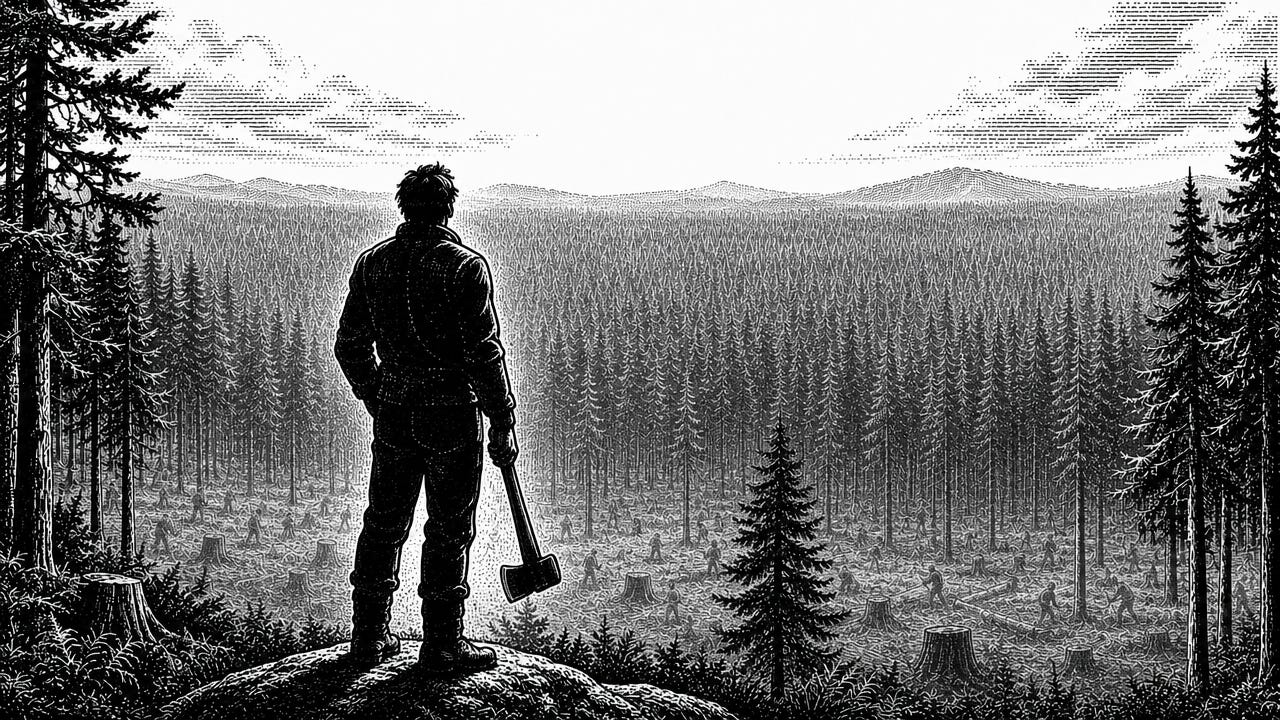

For the last twenty years, the fastest way to win was to out-execute everyone else.
Ship faster. Post more. Build more. Outwork the competition until they gave up before you did. Every self-help book, every “hustle culture” account, every productivity system, all of it was pointed at the same target: do more, faster, than the person next to you.
That advice wasn’t wrong. It was just temporary.
AI didn’t just speed up execution. It broke the entire premise the advice was built on.
The thing nobody wants to admit
Most people who call themselves “hard workers” are actually just comfortable doers. Doing is safe. Doing gives you something to point at by 5pm. Doing lets you avoid the much scarier question sitting underneath it: is this even the right thing to be doing?
That question requires thinking. Real thinking, the kind that sits with uncertainty, tests assumptions, and sometimes concludes that the thing you’ve been building for six months should be killed. Execution doesn’t require any of that. Execution requires only that you already know what to do, and now you just have to do it.
That’s why so many people default to execution mode. It’s not laziness. It’s avoidance dressed up as productivity.
What happens when execution is free
Right now, AI can write your first draft, build your MVP, design your logo, plan your launch sequence, and generate a hundred variations of your ad copy, in the time it used to take you to open your laptop.
This is the part everyone’s celebrating. And they should, for the individual creator, this is the greatest unlock in a generation.
But it comes with a brutal side effect: if execution is now instant and nearly free, it stops being a competitive advantage. It becomes table stakes. Everyone has the hammer now. The hammer isn’t the moat.
Which means the businesses, creators, and careers built entirely on “we execute well” are standing on ground that’s disappearing under them in real time. Not next year. Now.
The trap
Here’s the trap: the more comfortable you get at doing, the easier it is to mistake motion for progress, and now that AI can generate infinite motion for you, that mistake gets infinitely easier to make.
You can spend all day “shipping.” Fifty posts. Ten prototypes. A dozen cold emails. All AI-assisted, all fast, all — technically — output. And still end the year in the exact same place you started, because none of it was pointed anywhere.
Execution without direction used to be slow enough that it self-corrected. You’d run out of time or energy before you did too much damage. Now you can execute the wrong idea at a scale and speed that used to take a whole team. The trap isn’t doing too little. It’s doing too much, too fast, in the wrong direction, and calling it hustle.
What actually separates people now
If you strip execution out of the equation, because everyone effectively has the same access to it, what’s left is the only thing that was ever scarce:
Knowing which problem is actually worth solving
Knowing what “good” looks like before you’ve built it
Knowing when to stop, pivot, or kill something you’re emotionally attached to
Knowing what not to build, post, or chase, out of the infinite options now available
None of that is a skill you can prompt your way into. It’s built the slow way, through reps, failure, reflection, and enough pattern exposure over years that you start to feel the right answer before you can fully explain it.
Getting out of the trap
The way out isn’t to stop executing. It’s to change the ratio.
Spend real, undistracted time, before you touch a tool, deciding what’s worth making. Sit with the question longer than feels comfortable. Let AI compress the doing phase so aggressively that it frees up hours you can reinvest into the deciding phase, instead of just using that freed time to do more of the wrong thing, faster.
The people who win the next decade won’t be the ones who execute fastest. Everyone will execute fast. They’ll be the ones who spent the time everyone else saved on thinking harder about what deserved to be executed at all.
– Kal