

The Death of Average Intelligence
It did not happen suddenly. It happened the way most important things happen. Gradually and then all at once.

For most of human history being reasonably intelligent was enough.
Not brilliant.
Not exceptional.
Not the kind of mind that produces ideas nobody has had before.
Just capable. Organised. Able to learn the rules and apply them reliably. Able to communicate clearly and analyse information competently and produce work that met the standard.
That was the contract.
Get educated.
Develop competence.
Become useful.
Get rewarded for being useful.
It worked for a long time because intelligence was scarce.
If you could write clearly in a room full of people who could not you had leverage.
If you could analyse a problem systematically when most people could not you had value.
If you could organise information and present it professionally you were worth paying for.
The scarcity of competence was the source of the value.
That scarcity is ending.
Not because humans became less intelligent.
Because average intelligence became abundant.
That distinction matters more than most people have yet understood.
The commoditisation nobody talks about honestly
Every generation has watched a tool commoditise something that used to require human effort.
The calculator commoditised arithmetic. Not the mathematician. The person who spent their career doing sums by hand.
Google commoditised recall. Not the thinker. The person whose value came from knowing more facts than the people around them.
AI is commoditising something deeper than arithmetic or recall.
It is commoditising structured cognition.
The ability to take information and organise it clearly.
To take a problem and analyse it systematically.
To take a brief and produce competent output that meets the standard.
These things used to require a human mind.
They increasingly do not.
The average email. The average report. The average analysis. The average first draft of almost anything.
AI produces these at a quality that was previously human and at a speed and scale that no human can match.
This is not about the genius being replaced.
The genius was never in danger. Original thinking. Genuine synthesis. The ability to see what nobody else has seen and say it in a way nobody has said it. That remains irreducibly human for now.
It is about the middle.
The comfortable middle that educated people have occupied for decades. The space between genius and incompetence where most of us have lived. Where being smarter than average guaranteed relevance. Where credentials and competence and professional presentation were sufficient proof of value.
That middle is collapsing.
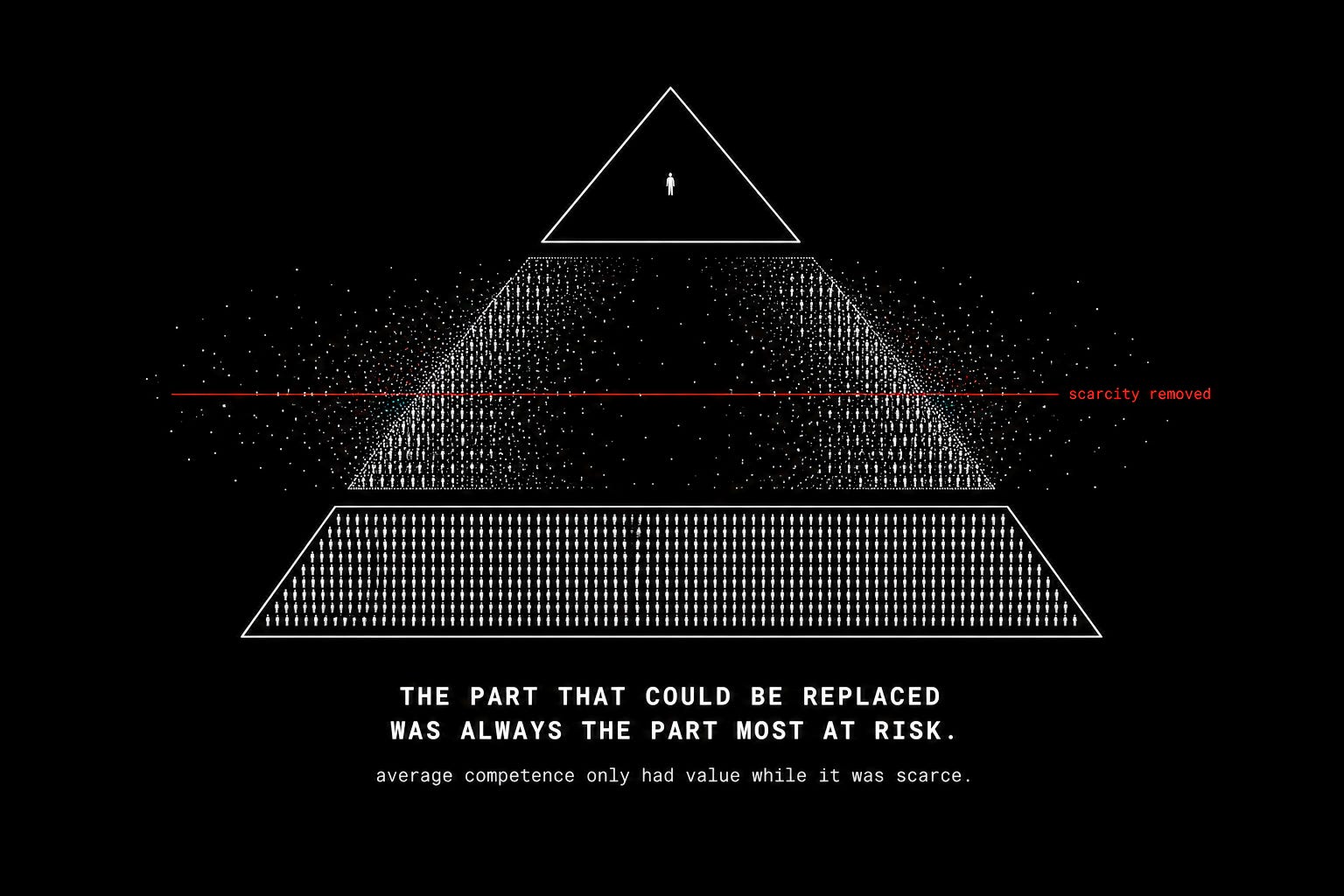
Not slowly. Quickly now.
The identity problem nobody is naming
Here is the part that makes this genuinely unsettling rather than just intellectually interesting.
Most educated people built their identity around being above average.
Not exceptional. Just reliably better than most.
The good student.
The competent professional.
The person who could always be counted on to produce something solid.
That identity was real. It was earned. It worked.
But it was contingent on a world where average intelligence was scarce.
In a world where AI can produce average output on demand the identity built around being above average loses its foundation.
Not all at once. Not in a way that announces itself clearly.
Just the slow erosion of the specific advantages that used to make above average feel like enough.
The anxiety many knowledge workers are feeling right now is not about job loss in the crude sense.
It is about the specific realisation that the thing they spent years becoming good at is no longer as scarce as it was when they started becoming good at it.
That is an identity crisis. Not just an economic one.
And it is hitting people who were told their whole lives that education and competence and working hard at becoming capable would be enough.
They were not lied to exactly.
The world just changed faster than the advice did.
What the education system built and what it forgot
The modern education system was designed during the industrial age to solve an industrial problem.
How do you produce large numbers of people who can follow instructions reliably. Who can absorb information and apply it consistently. Who can be trusted to perform defined tasks to a defined standard.
The answer was standardisation. Curriculum. Grading. Credentials. The whole apparatus of measuring whether someone can do what they were taught to do in the way they were taught to do it.
It worked.
It produced the workforce the industrial economy needed.
The problem is that the industrial economy is not the economy that exists now.
The economy that exists now rewards something the education system was never designed to produce.
Not compliance. Adaptability.
Not memorisation. Synthesis.
Not following the procedure correctly. Knowing when the procedure is wrong and what to do instead.
Not being reliably average. Being originally useful.
The education system is still optimising for the first column.
The world is increasingly only paying for the second.
What actually has value now
Not IQ in the raw sense.
Not credentials in the traditional sense.
Not even expertise in the narrow sense of knowing more about a specific subject than most people.
What has value now is something harder to name and harder to test and therefore harder to manufacture at scale.
Judgment. The ability to look at a situation with all its complexity and ambiguity and decide what actually matters and what to do about it. Not by applying a procedure. By thinking.
Taste. The ability to know what is good. Not just what meets the standard. What is actually worth doing. What is true. What is worth saying. What should exist that does not yet. AI can produce average. It cannot yet decide what is worth producing.
Synthesis. The ability to take ideas from completely different domains and find the connection that produces something new. To read widely and think across categories and arrive at a perspective that is genuinely yours because it emerged from a combination of inputs that only you experienced in the specific order you experienced them.
Sustained attention. The ability to think about one hard thing for a long time without reaching for something easier. This sounds simple. In a world designed to fragment attention it is increasingly rare. And the problems worth solving almost always require sitting with something difficult longer than feels comfortable.
The ability to learn faster than systems change. Not what you know now. How quickly you can know something new when the situation requires it.
These things cannot be automated because they are not procedures. They are capacities. Developed through living and thinking and being wrong and adjusting and living some more.
They are what remains when everything that can be automated has been automated.
The transformation this requires
The death of average intelligence is not the end of human value.
It is the end of passive value.
The value that accrued from being competent in a world where competence was scarce. The value that came from meeting the standard when most people could not. The value that arrived automatically from having done the credential and developed the skill and shown up reliably to apply it.
That value is evaporating.
What replaces it is not more competence.
It is a different relationship with your own thinking.
Not using your mind to produce average output faster than someone without your training.
Using your mind to produce things that could not have been produced without your specific experience of being alive.
Your specific perspective.
Your specific combination of things you have read and people you have known and problems you have faced and ways you have failed and rebuilt.
That is not reproducible.
AI can approximate it. Can produce something that looks like it from the outside.
But the approximation is recognisable as an approximation to anyone paying attention.
Because the real version has cost in it.
The cost of having actually been through something. Of having thought about something long enough to genuinely understand it rather than just accurately describe it.
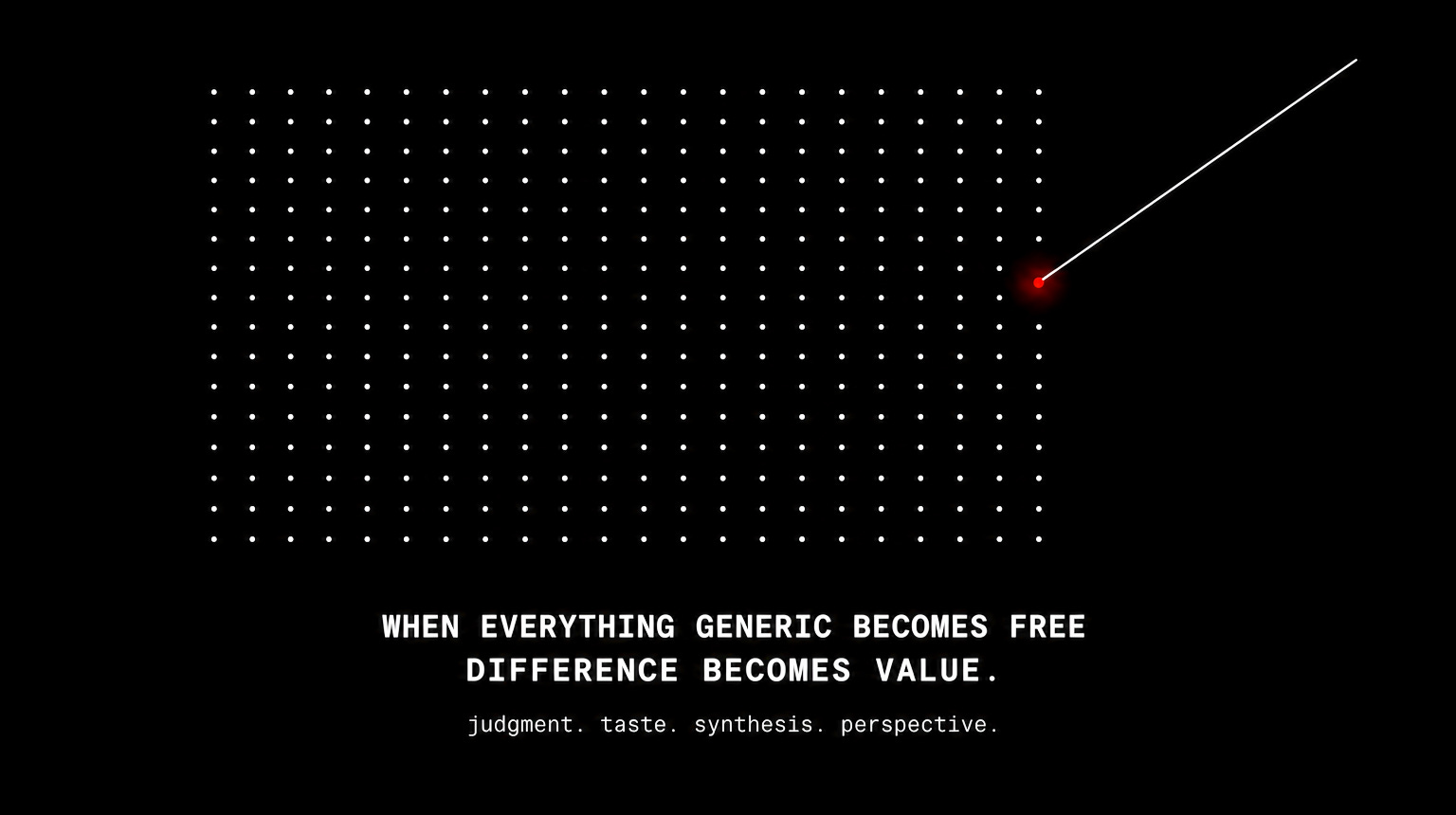
When information becomes infinite judgment becomes priceless.
When average output becomes free original thinking becomes the only thing worth paying for.
The death of average intelligence is not a crisis for the person who was never relying on being average.
It is an invitation.
To stop optimising for the middle.
To stop performing competence in systems designed to measure competence.
To start developing the capacities that remain irreducibly yours.
Judgment. Taste. Synthesis. The ability to think when thinking is no longer required.
Those things were always worth having.
They are just the only things worth having now.
🔗 Signal Links
Not everything earns attention. These did.
Paul Graham — Superlinear Returns — Written before the current AI wave but more relevant now than when it was published. The difference between good and great is no longer linear. Average does not just earn less. It earns almost nothing. Read this alongside this essay.
The Coming Wave — Mustafa Suleyman — The most honest book written by someone who actually built the technology. Not alarmist. Not optimistic. Just clear about what is actually happening and why most people are not ready for it.
Cal Newport — Deep Work — The argument that sustained attention is becoming simultaneously more rare and more valuable. Everything in this essay points back to what Newport described before most people were paying attention.
Naval Ravikant — Specific Knowledge — The argument that the only knowledge worth having is the kind that cannot be taught. That emerged from your specific curiosity and experience. That looks like play to you and work to everyone else. The most useful single page on the internet for understanding what value means now.
– Kal