


Most people have spent longer choosing a TikTok than deciding what they want their life to look like.
Not because the question doesn’t matter.
Because it feels too large to answer properly.
Designing a life sounds like something that requires months of reflection.
A retreat.
A journal you keep for a year.
Enough distance from your normal days for clarity to finally arrive.
That belief kept me waiting for more than a decade.
The clarity never came.
The opportunities did.
An unwritten life rejects nothing
Marketing agency. Web design. SaaS. Dropshipping. Print on demand. Lawn mowing. Rank and rent. Ecommerce.
Every new model looked like it might be the one.
I would find an opportunity, become convinced it could work, and start building. When it didn’t become what I expected, I blamed the vehicle and looked for another.
The vehicle was rarely the real problem.
I had never written down what I needed it to carry me toward.
Without that answer, every promising opportunity looked useful. There was nothing underneath my decisions separating movement from progress.
I could say I wanted freedom. I could say I wanted meaningful work, control over my time, and enough money to have options.
Those answers sounded clear until I tried to use them.
Almost any business can be described as a path to freedom. Almost any project can be made to sound meaningful. Vague ambitions reject nothing, which means they decide nothing.
A life kept entirely in your head stays negotiable.
The page makes you choose.
Clarity comes from writing, not before it
I used to think I needed to understand myself before I could write any of this down.
The order is the opposite.
Your head can hold ten possible lives at once. It can keep every door open, preserve every contradiction, and delay every difficult choice.
A page cannot.
The moment you describe one future in detail, you create something your real decisions can be tested against. It doesn’t need to be perfect. It only needs to be specific enough to disagree with.
That is what the hour is for.
Not to discover the final answer to your life.
To produce the first answer solid enough to test.
The system begins with five layers: a vision and anti-vision, goals, projects, and recurring tasks.
Then life begins supplying evidence.
Reflection helps you read that evidence. Adjustment lets you change the part of the system that no longer fits.
The first hour builds the map.
The repeating loop keeps the map connected to the ground.
The first fifteen minutes define a life worth building
Start with one specific day you would want to live repeatedly.
Not your dream holiday. Not the day you sell a company or reach a number in your bank account.
An ordinary weekday.
Where do you wake up? Who is near you? What work is waiting? What does your body feel like? How much of the day belongs to you?
Mine is a Tuesday morning in Queenstown.
No alarm. Mountains outside. Coffee while the lake sits still. One difficult piece of work that deserves my best hours. Time to move my body. People around me I don’t have to perform for.
That morning has become more useful to me than the word freedom ever was.
Freedom is abstract. Tuesday is not.
The Tuesday Morning I’m Building My Life Around

I often think about a Tuesday morning in Queenstown.
No alarm. I open my eyes to the mountains, make some coffee, and watch the lake sit still.
There is one difficult task waiting for me. Something meaningful that deserves my best hours, not whatever energy I have left after commuting, sitting through meetings, and trying to impress someone at a performance review.
I can look at a business, a project, or a job and ask whether it makes that morning more or less likely. I can ask whether the work protects my time and attention or consumes them. I can ask whether success would create the life I want or trap me inside a more impressive version of the one I’m trying to leave.
A vision becomes useful when it can reject something.
Give this part fifteen minutes. Write quickly enough that you cannot turn it into a performance.
The next ten minutes show you where the default ends
A vision gives you one direction.
You also need the other one.
Write an ordinary day from the life you are afraid of reaching by accident. Make it as specific as the first.
Mine is not difficult to imagine because I have already lived parts of it.
I’m still switching business models every eighteen months. Still calling it flexibility. Still becoming excited by each new opportunity because I have nothing underneath it deciding what matters. Still busy. Still unable to explain what a good day looks like.
The anti-vision matters because the life you don’t choose rarely arrives as a disaster.
It arrives as a sequence of reasonable decisions.
One good opportunity. One more year. One project that pays well but leads nowhere you want to go. Each choice makes sense on its own.
Then enough of them accumulate to become a life.
Your anti-vision gives that drift a visible destination.
Ten minutes is enough. You probably know more about the life you don’t want than you have allowed yourself to admit.
The next fifteen minutes give the vision a timeline
Turn to the second page.
Write what needs to be true ten years, five years, three years, and one year from now.
The distances matter.
Ten years gives you permission to think beyond your current circumstances. One year forces the answer back into reality. The years between expose whether there is a path connecting the two.
Run every goal against the first page.
Does this goal make the vision more likely?
Does it move you further from the anti-vision?
If you cannot explain how, remove it.
This is where borrowed goals become obvious. The income target you chose because someone else announced theirs. The audience size that sounds important but changes nothing about the work you want to do. The business you want because the model is trending, not because its demands fit the life beneath it.
A goal is not valuable because it is difficult.
It is valuable because of what achieving it makes possible.
The next ten minutes decide what deserves the work
Goals are too distant to work on today.
Projects are not.
Write the few projects that could move your one-year goals forward. Beside each one, write a sentence explaining the connection.
If the sentence is weak, the project is weak.
This would have saved me years.
I started businesses because they looked like good opportunities. Some of them were. That was never enough.
A good opportunity can still be wrong for your life.
The leather brand carrying my grandfather’s name taught me that most clearly. It mattered to me, but the way it would have needed to grow began pulling it away from the standard I wanted the name to represent.
Continuing might have looked like commitment from the outside.
Closing it was the more honest decision.
The project made sense until I tested it against something deeper than whether it could make money.
That is what this page gives you.
A reason to say no that is stronger than excitement.
The final ten minutes bring the system into real life
The last layer is the smallest and the one you will actually live inside.
Write the recurring tasks that keep your projects moving. Separate them into five intervals: daily, weekly, fortnightly, monthly, and yearly.
Daily tasks are the actions that need consistent attention.
Weekly tasks keep the work moving beyond any single day.
Fortnightly tasks create enough distance to notice whether momentum is building or whether you are repeating the same week without progress.
Monthly tasks give you space to review results, make decisions, and correct the direction.
Yearly tasks bring you back to the larger questions that disappear inside ordinary days.
Not every interval needs a long list. Some may need only one task. The point is not to fill every category.
The point is to make sure the work you repeat is connected to something you chose.
Every recurring task must serve a project. Every project must serve a goal. Every goal must move you toward the vision and away from the anti-vision.
If the line breaks anywhere, the task does not belong on the page.
Most people organise their lives from the bottom up. They collect tasks, turn the tasks into projects, and hope the projects eventually add up to a life they want.
This system works from the top down.
Life first.
Then goals.
Then projects.
Then the daily, weekly, fortnightly, monthly, and yearly work that makes the life real.
Sixty minutes.
Two pages.
A complete first version.
Reflection turns activity into information
The hour gives you a plan, but the plan is still an assumption.
You have described what you believe will move you toward the life you want. Now you have to live it long enough to find out whether you were right.
That is the purpose of reflection.
Without reflection, recurring tasks become habits you repeat because they are already on the list. Projects continue because you have invested time in them. Goals survive because changing them feels like admitting you were wrong.
The system becomes another default.
Reflection stops that from happening.
At each review, move back through the layers.
Did I complete the recurring tasks?
Did those tasks move the projects forward?
Are the projects producing the results the goals require?
Are those goals creating more of the life described in the vision?
Am I moving away from the anti-vision, or have parts of it begun appearing in my normal days?
The answers do not need to make you feel good.
They need to be accurate.
A system cannot correct what you refuse to see.
Adjust the layer where the problem exists
Reflection without adjustment is observation.
Once you see what is wrong, change the layer causing it.
If you are not completing a recurring task, the task may be too large, too frequent, or disconnected from the project it is supposed to serve.
If the tasks are being completed but the project is not moving, change the method or replace the project.
If the projects are succeeding but the goal no longer matters, change the goal.
If the goals are being reached but the life they create feels wrong, return to the vision.
The vision is not sacred because you wrote it first.
It is allowed to change.
You may discover that something you thought you wanted came from someone else. You may reach a goal and find that it gives you less freedom than expected. Your responsibilities may change. You may learn that the work you imagined enjoying is work you cannot respect once you are inside it.
That is not proof that the system failed.
That is the system working.
The mistake is not adjusting the vision.
The mistake is continuing to build toward something you no longer believe in because an earlier version of you wrote it down.
But adjustment also needs honesty.
Do not change the vision every time the work becomes difficult.
Do not replace a goal because the first attempt failed.
Do not abandon a project because another opportunity became more exciting.
Change the system when reflection gives you evidence, not when discomfort gives you an excuse.
The loop keeps the plan alive
The full system moves in both directions.
The vision shapes the goals. The goals shape the projects. The projects shape the recurring tasks.
Then reflection carries information back up.
What happens in your days tells you whether the tasks work. The tasks tell you whether the projects are moving. The projects test the goals. The goals reveal whether the vision describes a life you still want.
Then you adjust and move through the loop again.
This is not something you finish once.
The first hour gives your life a direction. The reflections that follow keep that direction honest.
The system protects the years
None of this guarantees that the next project will work.
It does not predict the market, remove uncertainty, or stop you from making mistakes.
It gives the mistakes somewhere useful to go.
If a project fails, you can learn from it without replacing your entire definition of progress. If a better path appears, you can test it against the same pages. If your vision changes, you can rewrite it deliberately instead of discovering years later that your life changed without you.
The pages are not a contract.
They are a filter and a feedback loop.
I spent years looking for the right vehicle before deciding where I wanted it to go. That made every failure feel like evidence that I needed a different model.
What I needed was something underneath the model.
A written life gives the work somewhere to point.
Reflection tells you whether it is getting there.
Do it before the next opportunity arrives
The temptation is to save this exercise for when things settle down.
They won’t.
There will always be another business model, another screenshot, another person making speed look like certainty. There will always be a reason to move first and think later.
Do the hour before the next opportunity arrives asking to be chased.
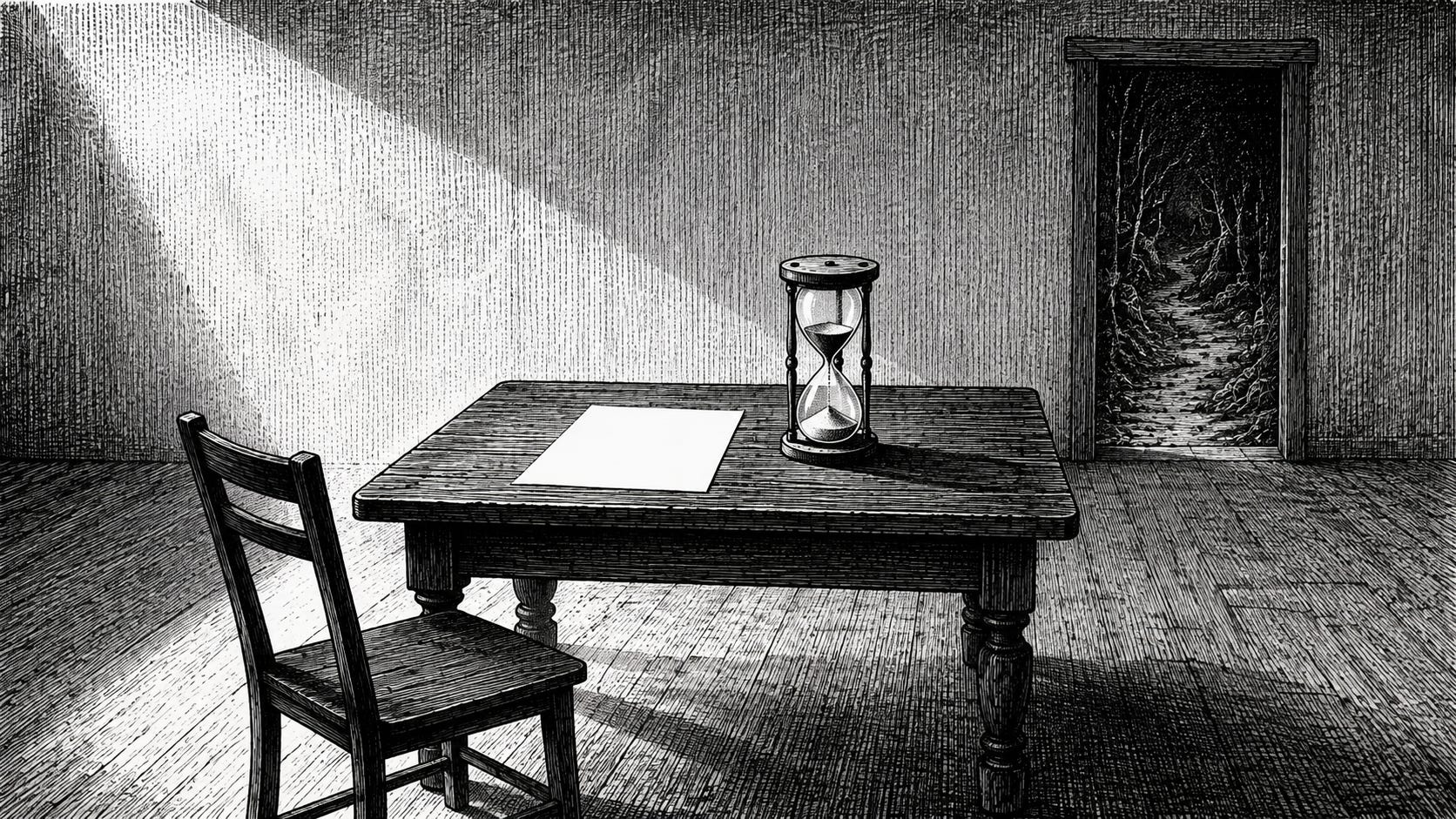
Put your phone in another room. Take two blank pages. Set a timer for sixty minutes.
Write the vision.
Write the life you refuse to drift into.
Turn both into goals, projects, and recurring work.
Then live it, reflect on it, and adjust it when the evidence tells you to.
You already have the hour.
You spent a worse one somewhere today.
– Kal